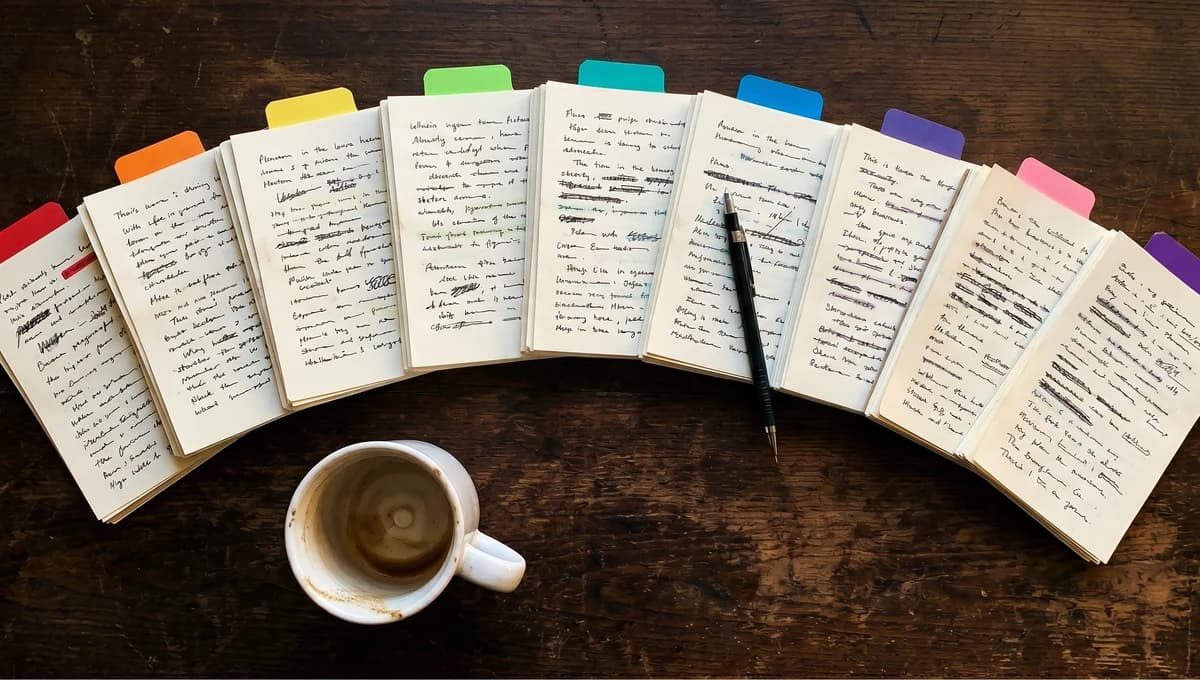
16 min read
Rewriting Unassisted: My 9-Draft Process for a Romance Novel
Nine drafts of Unassisted. What each fixed, what I cut, and the beta reader note that made me lie on the office floor at 3 AM.
Key Takeaways
- Most romance novels need five or six drafts. Unassisted took nine, because each layer tends to need its own pass.
- Cut beautiful scenes that do not belong. Revision is being honest about what the book needs, not what you love.
- A good beta reader is worth nine bad ones. Let the one whose taste fits your intent break you annually.
- A draft is done when your edits stop making the book better and start making it different. That is the signal.
Draft 7, 2 AM, the Scene That Would Not Cooperate
Draft 7. Two in the morning. If you are trying to figure out how to rewrite a novel and the same scene keeps breaking, I promise you, I have been in that chair. It was the scene where Declan finally tells Elena the thing he has spent a decade not saying out loud. I had rewritten it six times. It still read like two actors running lines. Cold coffee. Cat asleep on the keyboard, which is where she lives. Dog on my feet, which is where he lives. I was crying a little, which is less reliable, but it was happening.
I had a whiteboard of every "great emotional confession scene" I had ever underlined. I had the structure mapped out on index cards. I had the beat sheet. What I did not have was the scene. The scene was refusing.
That is the part nobody tells you about rewriting a romance novel. The hardest scenes are not the ones you do not know how to write. They are the ones you have written already, seven times, and still can't hear the character's actual voice inside them.
This is how I got Unassisted from "a draft I could technically call a novel" to "a book I was willing to put my name on." Nine drafts. Each fixed a specific thing. Some I am still not sure I fixed correctly. I will flag which ones.
Draft 1: The Book I Thought I Was Writing
Draft 1 of Unassisted was not a forbidden patient/therapist romance. This is going to be the first of several admissions.
Draft 1 was a straight enemies-to-lovers between a hockey captain and a sports journalist. Yes. The journalist who eventually became Renee in Book 2 was originally the Book 1 heroine. I wrote 82,000 words of it. It was fine. "Fine" is the diagnosis I gave Declan in chapter 3 and the diagnosis of Draft 1 as a whole.
The problem I did not see yet: I had written a book about two people having clever arguments instead of a book about two people who were afraid of each other for legitimate reasons. There was no structural barrier. A journalist can, technically, decide to cover a different team. The "forbidden" had the weight of a coat rack.
I thought the book was about wit. It was supposed to be about armor. I did not know the difference yet.
I remember the exact moment Draft 1 died. I was in the shower (which, for the record, is technically my writing room, though my dog disagrees), and I realized the scene I had just written was the third time Declan had made a sharp comment at a press conference. Because I had nothing else for him to do. That scene died in the shower. The book died with it.
Draft 2: The Scene I Cut That I Still Miss
Draft 2 is where I rebuilt Unassisted with the patient/therapist premise. The forbidden barrier was now structural: morality clause, licensing board, actual consequences that exist whether or not the plot wants them to.
Draft 2 also had a brother subplot. Declan had a younger brother who was a minor-league call-up. A whole parallel arc about inherited talent, the guilt of having made it when someone you love has not, the loneliness of being the family success story. I loved it. I wrote three chapters of it. I cried at my desk reading draft 2's Thanksgiving scene where the brother visits and Declan does not know how to talk to him.
I cut it in Draft 3. All of it. Every word.
I miss it. I still think about that Thanksgiving scene. If you pushed me, I would say the brother subplot is the best thing I have ever written that no one will ever read. The cut was the right call. Declan needed to be isolated (no family safety net, no parallel confidant, nobody who could receive the truth off the clock), and the brother was structurally in the way of that isolation. I killed him, editorially. I still feel weird about it.
A scene being beautiful is not the same as a scene belonging in the book. You cannot lobby for the brother. He has to earn his chapter the same way every other chapter earned its place. He didn't. He was there for me, not for the story.
Draft 3: The Shoulder Becomes the Architecture
Draft 3 was the draft where I finally understood what the shoulder injury was.
In Drafts 1 and 2, Declan's shoulder was the inciting incident. He got hurt. He needed rehab. Elena showed up. Context established, let us get to the romance. The injury was the reason they were in a room together, nothing more.
In Draft 3, I realized (slowly, stupidly, over about three weeks) that the shoulder was not just the reason they were in a room together. It was the shape of the whole book. Declan's labral tear is a man whose professional life has been built on compensating for pain. His body is literally guarding against the injury he will not name. His psyche is doing the same thing with the rookie-year betrayal he has spent ten years not talking about.
Once I saw that, every rehab session could do double work. Elena's assessment of his range of motion is also an assessment of his emotional guarding. When she says "you are compensating here," she is correct about both things. The clinical vocabulary became the novel's spine.
This is where the Translation Game was born. Draft 3 is where I started writing scenes where the medical language and the intimate language run on the same line. She says posterior capsule; he hears her. She says "I think we have some work to do"; they both know what she means.
Draft 3 is also where I stopped being afraid of third person. The first two drafts were in first person present, because Books 2 through 5 are. Draft 3 rebuilt the whole book in third person deep POV, the only way the Translation Game works. You need the narrative distance to let both characters' internal languages hit the same page. I will die on this hill.
Draft 4: The Opening That Starts Thirty Pages Later
Draft 4 was the draft where I threw out the first thirty pages of my own book.
The original opening was a training-camp scene. Declan playing at the top of his game. Establishing the team, the culture, the relationships. Introducing Ben, Vince, the coaching staff. Ending with the injury at the end of Chapter 2.
My beta reader for Draft 3 (who is also my cat's primary rival for desk territory, but I trust her) wrote a single sentence in the margin of page 4: "When does the book start?"
Reader, the book started on page 31.
Draft 4 cut the entire training-camp sequence. The book now opens with Declan already injured, three weeks into a protocol he has no faith in, on the morning Elena is flying in. You get the wound before the backstory. You meet Declan defending against a threat before you meet Declan at baseline, which is, incidentally, how Declan meets every person in his actual life.
The scenes I cut were not bad. They built the world. They delayed the thing that actually mattered: putting Declan in a room with Elena and letting the reader feel the charge before either character names it. In media res is not a gimmick. It is permission to trust the reader.
I still have those training-camp pages in a file called "unassisted_deleted_scenes.docx" which I will never open again because it is both sad and bad for me.
Draft 5: The Shower Moment About Elena's Refusal
Draft 5 is the Elena draft.
Drafts 1 through 4, Elena was functional. She showed up. She did her job. She had the backstory (misconduct report at sixteen, institutional betrayal) and the clinical vocabulary. She was, structurally, a whole person. She was also, emotionally, a little too available. She wanted the rehab to go well. She was rooting for Declan in the way a well-meaning side character roots for the protagonist.
I was in the shower (which is really my main problem-solving environment, I cannot defend this), and I had this thought: Elena would rather be wrong about a diagnosis than be caught performing softness. That is the whole character. She is not clinical because she is cold. She is clinical because at sixteen, when she told the truth about something that mattered, the community decided the person who saw clearly was the problem. So now she never lets her seeing slip into softness, because soft is exactly what they punished her for having.
I wrote that down on a bath mat with the pen from the counter. I still have the bath mat. It says "do not perform" on it.
Draft 5 rewrote every Elena scene with that single rule: she never performs softness. She feels it. She acts on it. She does not perform it. When she touches Declan, she does it with clinical exactness, because clinical exactness is the only register that is hers, and giving him that register is already the intimacy. The trail of her fingers across his shoulder in chapter 25, when she finally releases him and her fingers drag instead of lift cleanly, that one-second variation, is the entire relationship.
Draft 5 was Elena finally existing as a defense, not a helper.
Draft 6: The Beta Reader Who Said "Declan Sounds Like He's Reading a Script"
Draft 6 is the one that broke me. I sent it to four beta readers. Three had small, reasonable notes. The fourth sent a four-page document. Halfway down page two, in a section about Declan's internal monologue, she had written, exactly: "Declan feels like he is reading a script." Followed by: "I can see the author trying to make him stoic. I cannot see him."
I did not sleep that night. I lay on the floor of my office, which is a move I had only previously made in movies, and my dog came and sat on my ribcage, which was both comforting and not good for my breathing. I considered, briefly, quitting. I considered, less briefly, deleting the entire manuscript. I did neither. I stayed awake until 4 AM reading the rest of her notes.
She was right. Declan was reading a script. I had been so careful to make him "not a typical alpha hero" that I had scrubbed his voice down to someone performing unspecified pain at the reader.
Draft 6 is the one where I rewrote every Declan POV chapter by stripping out 40% of his internal monologue. The rule: if the thought was about how he was feeling, it got cut. He only got to think about what he was doing, what was in the room, and what his body was doing without his permission. The reader had to infer emotion from the specificity of what he noticed. Hair down on the bus. The fingernail he kept picking. The way the coffee steam was hitting his face. He could not tell you he was in love with Elena. He could only tell you, in precise detail, exactly how many times she had blinked in the last forty seconds.
That beta reader is still my beta reader. I buy her expensive coffee now. A good beta reader is worth approximately nine hundred thousand dollars. I pay in coffee.
Draft 7: The Off-the-Record Dialogue
Draft 7 is where the signature technique that runs through all five Ice and Instinct books finally landed.
I do not write misunderstandings. That is the rule. If a conflict could be resolved by one clear conversation, it is not a conflict, it is a plot device. The problem with forbidden romance in particular is that the main characters have structural reasons to not say the true thing: morality clause, professional code, career. But they also have to say true things to each other for the book to work. How do you give two people permission to speak honestly when the rules of their world specifically punish honest speech?
The Off-the-Record moment. The shift from the on-the-record register (professional, careful, coded) to the off-the-record register (true, specific, consequence-free) happens through a line, an acknowledgment, a physical signal. In Unassisted, it is often a pause before a clinical phrase, where Elena chooses to say something honest in medical vocabulary.
In Draft 7, I figured out that the Off-the-Record moment is not a device. It is the entire romance. The book is not about when Declan and Elena get physical. It is about when they have permission to be honest. That moment is worth twenty pages of buildup.
The 2 AM scene at the top of this post, the one I rewrote six times, was the scene where Declan first gives himself permission to be off the record with Elena. Draft 7 finally got it when I stopped trying to write the confession and started writing the permission. The thing he tells her is not the scene. The scene is the moment he decides the rules no longer apply in this room.
That one broke in the seventh version. 2:47 AM. The coffee had a skin on it. I read the scene back and my cat, for the first time in the entire drafting process, judged me. In a good way.
Draft 8: Heat Scenes, Rewritten for Less Explanation
Draft 8 is the draft I rewrote every heat scene in. Five scenes. Not because they were not explicit enough. Because they were too explained.
The Draft 7 versions were anatomically correct, emotionally charged, and fully narrated by two people thinking in complete sentences. Which, for the record, nobody does during sex. It read like two people reviewing their own experience in real time.
The rule in Draft 8: the body outruns the mind. The internal monologue had to fragment. The sensory detail had to carry more weight than the emotional analysis. You can be explicit without being explained.
The chapter 17 scene ("The Full Door") is the one I am proudest of from Draft 8. The original was 3,400 words. The Draft 8 version is 2,100. The cut 1,300 words were Elena and Declan explaining to each other what was happening. You do not need to explain what is happening if you trust the reader to feel it.
I will admit a weakness: I am still not sure I got this right in chapter 30, the pre-finals scene. I rewrote it three times in Draft 8 and twice more in Draft 9. It is still, to me, one sentence too chatty. The 10th draft is a lie I tell myself.
Draft 9: Knowing When to Stop
Draft 9 was not a draft. Draft 9 was a read-through with a pen.
I had been revising Unassisted for fourteen months. My cat had six months earlier stopped acknowledging any version of me that was not at a desk. My dog had learned that "one more chapter" is a temporal unit of indeterminate length.
Draft 9 was me reading the entire manuscript aloud. Every word. I did this in my living room, mostly to the dog, who did not enjoy it but was too polite to leave. I fixed about forty small things. A repeated "seemed" here. A rhythm in a dialogue exchange. One comma I moved three times.
By chapter 33, I was reading the championship scene aloud, and I got to the line "I love you" and my voice caught. Not because the scene was sad. Because it was done. I read the epilogue. I read the last line. I closed the laptop. I sent it to my editor at 2:14 AM.
Here is the lie I tell myself about Draft 9: that I knew it was done. I did not. What I knew was that I had stopped making it better. Every change I was making was lateral. Move a comma, move it back. Swap "said" for "murmured" and put it back to "said" an hour later. Draft 9 is the draft where you stop improving the book and start disturbing it. The work is to notice that moment and get out of the room.
I still have the instinct to reopen the file. I will not. The book is in a shelf now, which means the book is no longer mine.
The Frameworks I Actually Use Across Drafts
These are the principles I dragged out of those nine drafts. I use them on every book now. They are arguments I keep winning with myself.
Clarity before craft. If you do not know what the book is about in one sentence, it is not structurally sound. Every draft that did not work had a sentence I could not finish. Unassisted's sentence, as of Draft 3: "A hockey captain who has made himself unreadable meets an athletic therapist who reads everything." Before Draft 3, I did not have that sentence. It shows.
The scene belongs to the second character. The POV character thinks what they think. The scene's weight belongs to the other character, the one whose body and word choices are doing the silent work. In a Declan POV, I am not writing Declan. I am writing Elena through his attention.
Cut the explanation, keep the image. If I can imply it, I must imply it. If I have to tell the reader the emotion, the scene is already failing. The reader is smarter than the narrator. Treat them accordingly.
A good beta reader is worth nine bad ones. Find one person whose taste aligns with what you are actually trying to write, and let that person break you annually. You will live.
What I Still Get Wrong
I write through-lines well. I write first drafts too fast. I mistake "I know what I am doing" for "I know what this chapter needs." I write the climactic scene first in my head, then spend three drafts trying to figure out how to get the characters there, instead of starting from the characters and trusting them to find it.
I also, still, over-explain in every opening scene. Every first draft has a "too much setup" problem I have to cut in Draft 4. My beta reader has warned me about this three times across three different manuscripts. I have not yet beaten it. I will be beaten by it again on Book 6, I can feel it from here.
The same mistakes repeat. Mastery is not making fewer mistakes. Mastery is noticing them one draft earlier every time.
Frequently Asked Questions
How many drafts does a romance novel need?
There is no fixed number, but most romance novels need at least five or six drafts to land. Unassisted took nine. The number depends less on word count and more on how many layers the book is asking you to unify: voice, structure, pacing, heat, theme, subtext. Each layer tends to need its own dedicated draft. If you feel done at Draft 3, you are probably not done.
How do you know when a draft is done?
You do not, exactly. What you notice instead is the moment your changes stop making the book better and start making it different. When you move a comma back to where it was two days ago, that is the signal. Read it aloud. If your voice catches on a sentence that means what you meant, close the file. Send it. If you are still improving, keep revising. If you are disturbing, stop.
What is the hardest part of revising a romance novel?
Cutting the scenes you love that the book does not need. Every writer I trust has at least one Thanksgiving-brother-subplot of their own: a beautiful thing that is structurally in the way of what the book is trying to do. The hardest revision work is not writing better prose. It is being honest about what belongs in the book versus what belongs in the cutting-room file you will never open again.
The Book Is a Shelf Now
The last line of Unassisted is a line I wrote in Draft 3 and did not change in any of the subsequent drafts. I knew, the first time I wrote it, that it was the ending. I kept waiting for a later draft to fix it, because I did not trust a sentence that came that clean. It never needed fixing. Some sentences arrive whole. You wait nine drafts to find out which ones.
The manuscript pages are in a shelf now. My cat is on the keyboard. The dog has opinions about my next book. The coffee is cold. The desk lamp is on. It is the only writing room I have, and I am in it.