11 min read
Why I Left Corporate After 16 Years to Write Romance
A Gantt chart in a broken AC conference room was the moment I knew. Sixteen years in, what I got wrong, and what I kept.
Key Takeaways
- The moment you know you have to leave corporate is rarely a crisis. It is recognition of a pattern you built.
- Project management, stakeholder handling, and deadline discipline transfer directly into indie publishing.
- First time self publishing mistakes cluster around cover fit, skipped developmental edits, and schedule slips.
- Identity does not transfer overnight. A year in, the LinkedIn line still said Senior Manager.
Everyone Asks About the First Time Self Publishing Mistakes
Everyone wants to know the first time self publishing mistakes I made. I'll get to them, because I made a lot of them and some of them still make me physically wince. But first, let me tell you about the Tuesday I knew I had to leave corporate after sixteen years.
It was a Gantt chart. That's the stupid, anticlimactic truth. I was in a conference room where the AC had been broken for three weeks, holding a coffee that had gone cold two meetings ago, staring at a project timeline I had personally built. Every bar on that chart represented weeks of work I'd orchestrated. Every milestone was a thing I'd negotiated into existence with stakeholders in four different time zones. It was, objectively, a very good Gantt chart.
And I looked at it and thought, with the kind of clarity you usually only get in movies, "I have done this exact thing, in some variation, approximately four hundred times."
That's the part nobody tells you. The moment you know isn't a crisis. It's not burnout, not exactly. It's recognition. You see your own pattern from outside of it, and once you've seen it, you can't unsee it.
The 16-Year Arc, For the Corporate People Nodding Along
Here's the thing about corporate careers that I didn't understand until I was leaving one: they are designed to feel like progress. You get a new title every couple of years. You take on more scope. It's a conveyor belt, and the conveyor belt feels like choice because you keep getting promoted onto it.
I stayed for sixteen years because I was good at it, and being good at something is its own trap. I was the person they put on the hard stuff: the cross-functional initiative nobody else wanted, the stakeholder who was impossible to please, the system rollout three months behind schedule. I could walk into a steering committee where seven senior people had opposing priorities and leave an hour later with a plan that kept most of them alive. That skill is valuable. That skill also eats you, because the reward for solving a hard problem is always a harder problem.
I kept telling myself I liked it. The truth is I did like parts of it. I liked running a room. I liked the architecture of a good plan. I liked watching a team execute on something we had built together.
What I didn't like was that the list of things I'd always said I'd do "when I had time" kept getting longer. Writing a novel was on that list. It had been on that list for eleven years.
The Day I Decided
The decision happened in my car.
I want to say it was dramatic. I want to say I threw my laptop bag across the parking structure. What actually happened: I sat in the driver's seat after a skip-level meeting where my boss's boss had, very kindly, laid out a three-year plan for my next promotion. He was excited for me. He had spent real time thinking about it. The plan was good. It was the kind of plan you'd pay a career coach to build.
And I sat there, keys in the ignition, and I cried for twenty minutes. Not sad crying. The other kind. The kind where your body has figured something out before your brain has permission to say it out loud.
The thing my body had figured out: if I took the plan he was offering, I would be having this exact cry in three years, about whatever plan came next. The ladder keeps going. There is always another rung. The version of me who finally wrote the novel was not on any rung on that ladder. She had to get off.
I still haven't told my father. He's a practical man. Sixteen years of a good job translates into a specific kind of pride for him, and I don't yet know how to tell him I traded it for a desk with a cat on the keyboard. I'll figure that part out. For now, the book that became Unassisted is on his shelf, and he's read it, and I think that's the version of the conversation we're both allowed to have right now.
The LinkedIn Line Still Says Senior Manager
Here's a thing nobody warned me about: the identity doesn't transfer overnight.
I left in January. It's been over a year. My LinkedIn still has "Senior Manager" on it because every time I go to change it, I stare at the edit box and think, what do I call myself now? "Romance Author" sounds like something I haven't earned yet, which is wild because I've now published five books. "Author" by itself feels presumptuous. "Writer" feels like hedging. The cursor blinks. I close the tab.
The dented corporate ID card is still in the drawer of my desk. I didn't throw it out. I didn't cut it up. I just set it aside, and every few weeks I open that drawer looking for a pen and I see it and I have a very small, very specific feeling that I don't have a word for. Not regret. Not relief. Something in between. Sixteen years of showing that card at a security turnstile. You don't just unlearn that.
What I've figured out, slowly: the identity you built in corporate doesn't leave because you left. It just gets quieter. The project manager in me still runs the writing. The stakeholder whisperer in me still handles beta readers. You don't become a new person. You become the same person, pointed differently.
Why Romance, Specifically
People ask me why I didn't write literary fiction. The assumption, I think, is that sixteen years of corporate buys you a certain seriousness, and seriousness should produce sad books about people staring out windows.
I bounced off literary fiction years ago. I don't want to close a book and feel worse. I have access to the news. I have access to my own life. Romance promises the reader, structurally, that two people who are hurting each other at chapter eight will not be hurting each other at chapter thirty. That the wound will be seen. That the ending will hold.
That promise is a contract. Writing inside it is harder, not easier, because you can't cheat your way to depth. You have to earn the happy ending on the page.
I wanted to write books that people stay up too late reading. Books they send to a group chat at 2 AM with "I need someone to talk to about this RIGHT NOW." That's the genre. That's the whole point. And for the record, romance is the hardest genre to write well. Anyone who thinks otherwise hasn't tried.
What Corporate Gave Me That I'm Keeping
The corporate years were not wasted. That's the version of this story I want to sit with for a minute, because too many "I left my job to follow my dream" essays treat the previous life as a prison sentence. It wasn't. Here's what those sixteen years actually gave me.
Project management translates almost perfectly to drafting. A novel is a project with a due date, a scope, a set of deliverables, and a thousand small dependencies. When I was writing Unassisted, I built the draft the same way I'd built a six-month system implementation: work-back schedule from launch, critical path, risk register, check-in cadence. My critique partners thought I was unhinged when I sent them a Gantt-style tracker for my own manuscript. It worked. It still works. I have a spreadsheet for my current draft with tabs for pacing, heat scene placement, POV balance, and dialogue-to-narration ratio. You can take the Senior Manager out of the conference room.
Stakeholder management translates directly to ARC campaigns. Running an advance reader copy campaign is, structurally, a stakeholder management exercise. You have forty people who want different things. Some want acknowledgment. Some want early access. Some want to feel like insiders. Some want you to stay out of their inbox. The skill of reading a room of senior executives and knowing who needs what is the exact same skill that lets you write the right kind of check-in email to a reviewer who's stressed. Different stakes. Same muscle.
Deadline discipline translates to chapter cadence. Corporate taught me that a deadline is not a suggestion. It's a commitment to a set of people who have built downstream plans on your word. Writers who've never worked in corporate often treat their own deadlines as personal, as if the only person they're accountable to is themselves. Mine feel external. My beta readers are stakeholders. My ARC team has a go-live date. My readers who pre-ordered have a reasonable expectation. If I miss, the consequence is their trust.
Reading documents fast, finding the buried thing. Sixteen years of reading two-hundred-page decks with the real information buried on slide 147 taught me how to read my own manuscripts with the same ruthlessness. When my editor flagged a plot inconsistency in draft six of Unassisted, I found it in forty minutes. That's muscle memory from a decade of reading board packs on planes.
The First Time Self Publishing Mistakes, As Promised
You didn't come here for my career philosophy. You came here for the disasters. Fine.
Mistake one: the first cover. I had a concept I loved. It was atmospheric. It was moody. It was, in hindsight, entirely wrong for hockey romance. A friend who designs covers for a living looked at it and said, very gently, "This is a thriller cover." I argued. I had my reasons. I had mood boards. I had three pages of notes about the emotional tone of the book. She nodded patiently and then asked me one question: "What does an Icebreaker reader's shelf look like?" I had to admit that my cover didn't look like any of those shelves. I scrapped it. I paid for a new one. The new one did the work the first one couldn't. Lesson: a cover that makes you feel something specific is less important than a cover that tells a reader what shelf the book lives on.
Mistake two: the editor I didn't hire. I thought I could do a developmental edit myself. I had the manuscript in good shape, I'd read every craft book on the shelf, and I had a critique group whose notes were sharp. I was wrong. Draft seven had a structural problem I could not see from the inside, and I didn't see it until a sensitivity reader I hired for something else pointed out, in passing, that the pacing of my midpoint turn was forty pages off. Forty pages. I cried for a different reason that time. Lesson: hire the editor. Hire one who has worked in your exact subgenre. Your critique group can only do so much.
Mistake three: the launch schedule I missed. I set an initial launch date for Book 1 with the kind of confidence you get from someone who's never shipped a book before. I moved the date twice. The second time I moved it, I felt a grief I wasn't expecting. Not about the book. About the promise I had made to myself. I'd told a specific group of people the book was coming, and then I'd taught them I was unreliable. That's the part nobody tells you about launch dates: they aren't for the reader, they're for the writer. They're how you prove to yourself that you finish. I rebuilt my scheduling approach after that. Every subsequent book has shipped on the date I announced.
Honorable mention: pricing panic. I priced Book 1 at $4.99, panicked at sales numbers that were entirely normal for a debut, and dropped to $0.99 in a frenzy of midnight indie-author-forum reading. Sixteen years as a project manager and I still panicked. The $0.99 ended up being the right call, but I made it for the wrong reasons, which is a different kind of mistake.
The First Day I Wrote Full-Time
I had built this day up for years. The fantasy involved a perfectly organized desk, a pour-over coffee, and the kind of productive morning you see in writing influencer reels.
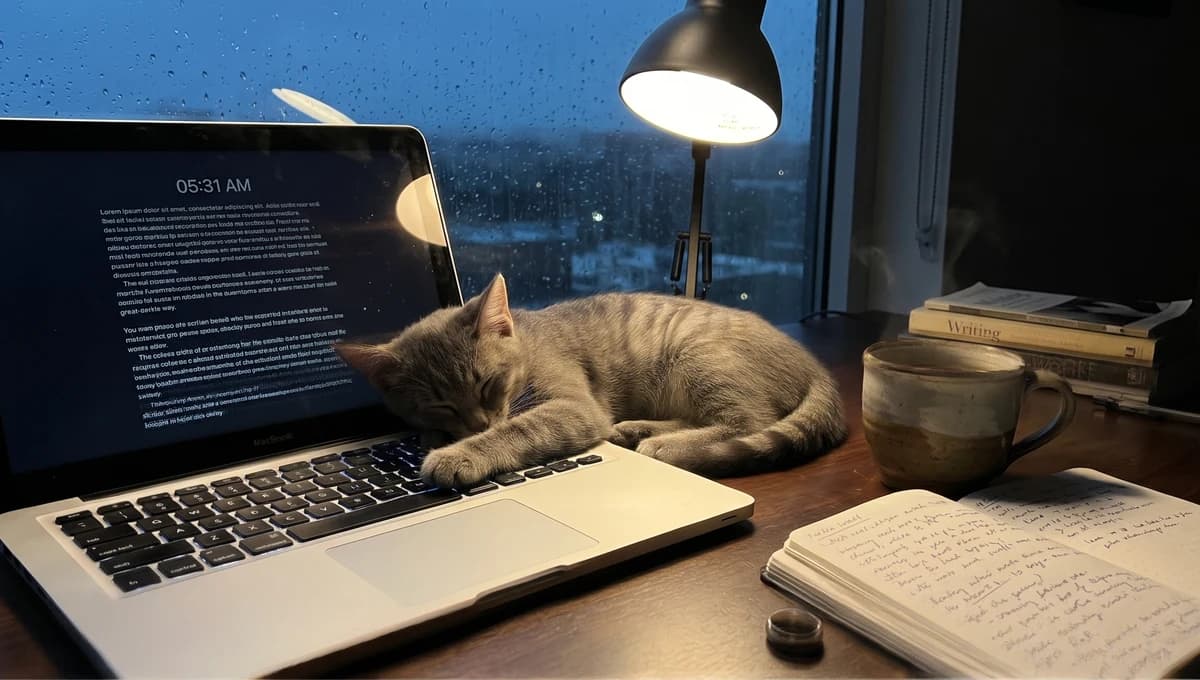
What actually happened: I woke up at 5:30 AM out of sixteen years of habit, made coffee the way I always make coffee (a relationship with my pour-over that most people would describe as codependent), sat down at my desk in pre-dawn dimness with one lamp on, and stared at a blank document for forty-five minutes.
My cat sat on the keyboard. She does this every morning. That day I didn't move her because I didn't have anywhere to be, and somewhere in the next hour I wrote about eighty words that I later deleted. The dog, who thinks he's a cat, came in and judged me from the rug.
I thought I'd feel triumphant. I didn't. I felt quiet. I felt the specific kind of quiet you get when the thing you've been using as motivation for a decade (the job you're leaving, the ladder you're climbing down) is suddenly gone, and what you're left with is just you and the sentence you're trying to write.
That's the thing about building a life around a goal. When you hit the goal, the scaffolding comes down, and the scaffolding was half the point.
It took me about three weeks to get a rhythm. I started baking sourdough in the afternoons, which sounds precious until you spend an hour proofing a dough and realize you just figured out what your third act needs. The Portland rain helped. The cat kept sitting on the keyboard. I wrote a scene, deleted it, wrote it again. The book that became Unassisted got its real spine during those weeks, not because I was finally "writing full-time" but because I had stopped optimizing my days for someone else's chart.
The Part Nobody Puts on LinkedIn
The honest answer to "how's full-time writing going" is: it's going. Some days I think about the dented corporate ID card and I miss the clarity of a stakeholder meeting. Most days I don't. The coffee is colder now because I forget it more. The dog has strong opinions about my chair.
Outside, the rain is doing what Portland rain does. Inside, there's a notebook open, and a silver ring on the desk next to it that I took off because it kept catching on the keyboard, and one lamp lit in the way I used to only see on 5 AM business trips to the east coast.
It's not what I thought it would look like. It's better and harder in specific, unsentimental ways. The novel was on a list for eleven years. Now it's on a shelf.